
Start C Programming
See C and memory, line by line
Conçue pour iPhone, iPad
Gratuit · Achats intégrés
- Classification d’âge4+
- CatégorieÉducation
- DéveloppeurCHUNGKIL KIM
- LanguesAnglais+ 1 de plus
- Taille57,2 Mo
Renvoie vers la page App Store officielle
Download.org n’héberge aucun fichier de Start C Programming. Le bouton ouvre la page de l’application sur App Store, où CHUNGKIL KIM la publie. Fiche vérifiée pour la dernière fois le 23/11/2026.
Captures d’écran




À propos
Le développeur n’a pas fourni ce texte dans votre langue.
Learn C by running code one line at a time and watching memory change.
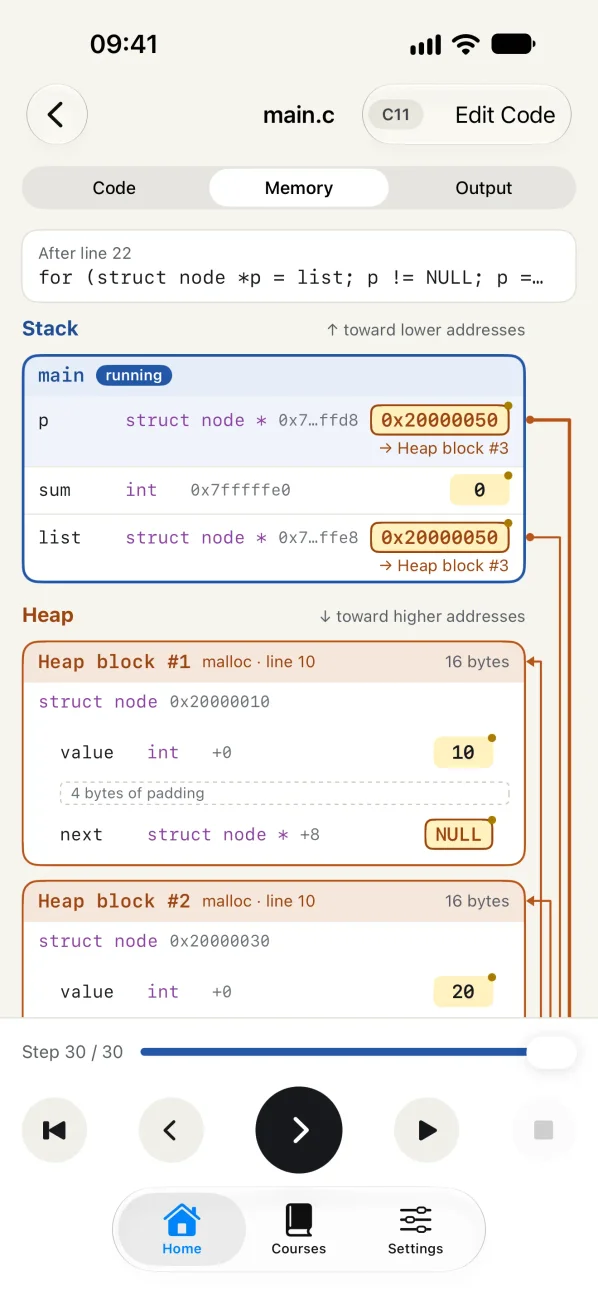
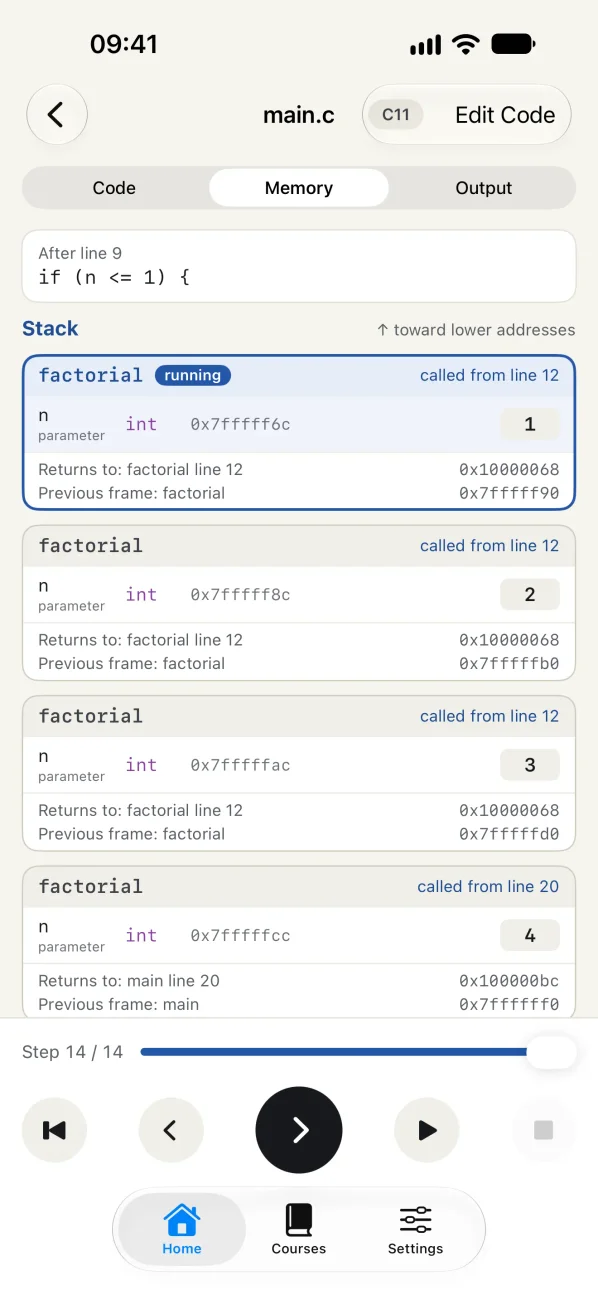
Pointers are hard because you cannot see them. Each time you run a line, this app draws the stack frames,
its variables, the heap blocks you borrow with malloc, and where each pointer points.
The last changed value turns yellow, and you can step back to see it again.
Step through and rewind
- Run to the next line, a breakpoint, or the end, or step back a line
- Watch frames pile up on each call and disappear on return
- Pointers are arrows, arrays are rows of slots, and structs show their members and padding
- Tap a variable to see its bytes in hex, decimal, binary, or characters
- Set scanf input, arguments, and files before you run
- Write your own headers and link several .c files, as in real C
- Processes and threads appear in tables, with pipes and sockets drawn
- A virtual microcontroller board shows LEDs, buttons, and registers
12 tracks and two appendices, 587 lessons
- Track 0 First steps in programming — hardware, the OS, bits and files, addresses, algorithms, recursion, and bugs (22 lessons)
- Track 1 Programming basics — values, conditions, loops, functions, arrays, and tracing code (21 lessons)
- Track 2 The C language — printf to pointers, structs, dynamic memory, file I/O, and function pointers (74 lessons)
- Track 3 Memory essentials — bits and bytes, the memory map, the stack and the heap, and memory bugs (33 lessons)
- Track 4 Executable essentials — compiling, linking, assembly, symbols and addresses, and executable formats (45 lessons)
- Track 5 Capstone projects — a string processor, a linked list, a memory allocator, an RPN calculator, and a word counter (29 lessons)
- Track 6 Systems programming — fork, pipes, threads, shared memory, and sockets, then a work queue and a chat room (51 lessons)
- Track 7 C for embedded development — registers, GPIO, timers and PWM, interrupts, UART, and flash and RAM on a virtual board (42 lessons)
- Track 8 Data structures in C — growing arrays, generic containers, hash tables, balanced trees, tries, and graphs, an LRU cache, heaps, range trees (43 lessons)
- Track 9 Building a language in C — undefined behavior, closures and exceptions in C, garbage collection, and a bytecode VM (35 lessons)
- Track 10 Algorithms in C — sorting, searching, backtracking, dynamic programming, greedy, and strings, measured in instructions (45 lessons)
- Track 11 Numerical methods in C — floating-point error, roots, interpolation, integrals, linear systems, ODEs, and Monte Carlo, with graphs (55 lessons)
- Appendix A Computing and the lineage of C — computing history and what C89 to C23 changed (51 lessons)
- Appendix B Computer science beyond C — algorithms, the CPU, OSes compared, networks, and limits of computation (41 lessons)
Lessons are short cards with examples you run in place, marked beginner, intermediate, or advanced.
Each module has a quiz, track modules have auto-graded exercises with hints, and each track ends with a final quiz.
A placement quiz suggests where to start.
Errors explained
- Errors and warnings are caught where clang catches them, with an explanation, a fix, and a related lesson
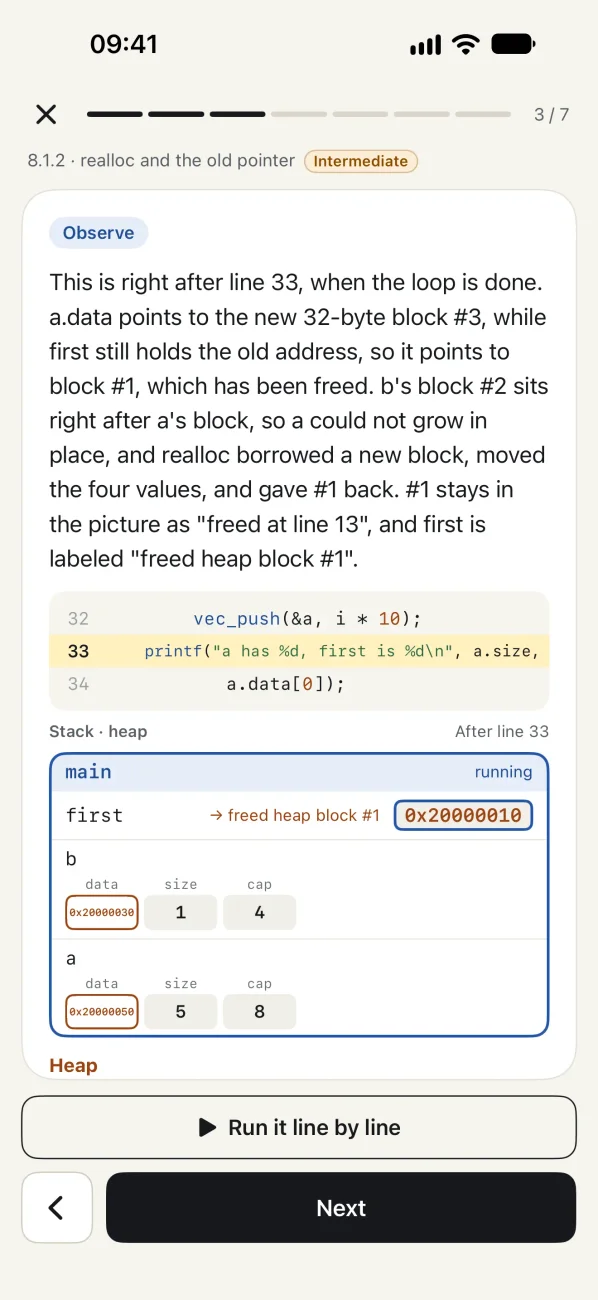
- Out-of-bounds writes, use after free, double frees, and leaks are caught where they happen
- Data races, deadlocks, and phone typos are flagged too
Like real C
- Supports C99 and C11
- Hundreds of test programs match clang on a Mac, down to the exit status
- Processes, sockets, and the virtual board run inside the app
On your device, with no internet
A C interpreter built into the app runs everything on your device. Progress syncs through your own iCloud.
There are no ads.
Start for free
Tracks 0 and 1, modules 2.1 and 2.2, the first module of Tracks 3 to 11, and both appendices are free. Other modules open with a one-time purchase per track,
including modules added later. One purchase works on both iPhone and iPad.
On iPad, code, memory, and output sit side by side, and you can open several windows.
Nouveautés
Version 1.13.0 · 14/11/2026
What's new in 1.13.0
- Module 2.2 "Types and operators" of Track 2 "The C Language" is now free, so the first two modules of Track 2 open without a purchase.
- Track 8 "Data structures in C" has a new advanced module, 8.8 "Range and probabilistic structures": build a binary heap, a Fenwick tree, a segment tree, a skip list, and a Bloom filter, and compare their step counts in graphs. It opens for everyone who already owns Track 8.
- Track 8 also has a new advanced module, 8.9 "Structures that manage their own memory": an arena allocator, a fixed-size pool, lists placed inside the struct, a bitset, and the nodes of a B-tree.
- Track 10 "Algorithms in C" has a new advanced module, 10.8 "Graphs in more depth": negative edges and Bellman–Ford, Floyd–Warshall, strongly connected components, the lowest common ancestor, and dynamic programming on a graph with an order. It opens for everyone who already owns Track 10.
- Track 10 also has a new advanced module, 10.9 "Advanced DP and math": states written in bits, DP on a tree, DP that merges ranges, counting with remainders, and matrix exponentiation.
- Track 11 "Numerical methods in C" has four new advanced modules: 11.8 eigenvalues and matrix decompositions, 11.9 optimization, 11.10 the Fourier transform and signals, and 11.11 a taste of partial differential equations, with graphs of convergence and divergence. They open for everyone who already owns Track 11.
- Each of the eight new advanced modules has an exercise where you write a whole function, and their explanations are filled out with memory pictures, diagrams, and cards that spell out the reasons. The final quizzes of Tracks 8, 10, and 11 include questions from the new modules.
- Track 4 has a new lesson, 4.7.7 "Dates and times", on printing dates with time_t, struct tm, and strftime, and counting days with mktime and difftime, with an exercise that finds the days between two dates. If you already finished Track 4, its final quiz opens again when you finish this lesson.
- A second review of C added cards for what was missing: integer division by zero, named constants, passing two-dimensional arrays to functions, overlapping copies (memmove), the %e and %o printf formats, more math, string, and character-class functions, abort, X macros, and signal handlers.
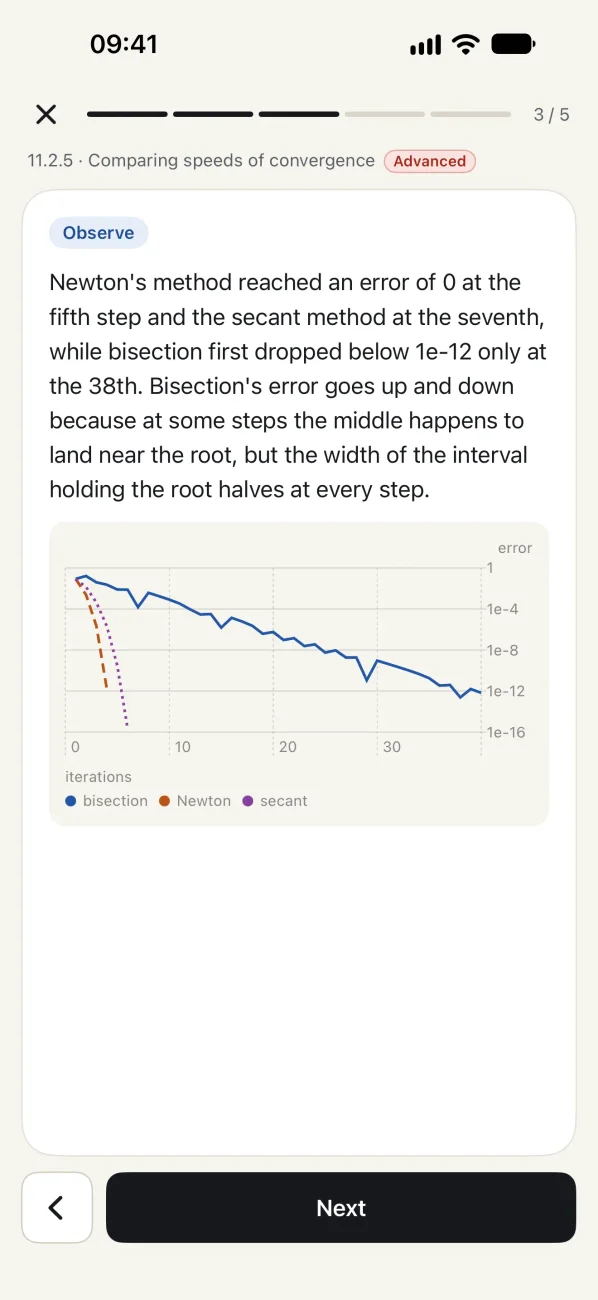
- Twelve lessons in Tracks 8, 9, and 10 and Appendix B now have graphs. They draw the numbers an example prints so you can see how things grow: array growth factors, hash table load factors, the memory of adjacency tables and lists, union-find, garbage collection thresholds, binary search, quicksort, insertion and counting sort, backtracking (N queens), recursion with memoization, the height of a lopsided tree, and cache misses.
- Lessons on floating-point numbers, random numbers, and math functions (1.2.4, 2.2.2, 2.4.6, and others) and the appendices now point to the Track 11 "Numerical methods in C" lessons that go deeper.
- Lessons in Tracks 8, 9, and 10 and Appendix B that show the same growth shapes now point to each other.
- On iPad, opening a graph card directly no longer shows a different example in the workbench on the right.
- One explanation in lesson 9.4.5 now matches the example's arithmetic.
Tell us about any problem through the support page.
Confidentialité de l’application
Ce que CHUNGKIL KIM déclare sur l’App Store au sujet du traitement des données par cette application.
-
Données n’établissant aucun lien avec vous
Peuvent être collectées, mais ne sont pas liées à votre identité.
- Contenu utilisateur
- Identifiants
- Données d’utilisation
- Diagnostic
Les pratiques en matière de confidentialité peuvent varier, notamment en fonction des fonctionnalités que vous utilisez ou de votre âge.
Informations
- Vendeur
- CHUNGKIL KIM
- Catégorie
- Éducation
- Version
- 1.13.0
- Mis à jour
- 14/11/2026
- Publié
- 11/10/2026
- Taille
- 57,2 Mo
- Nécessite
- iOS 18.0 ou version ultérieure
- Classification d’âge
- 4+
- Prix
- Gratuit
- Achats intégrés
- Oui
- Langues
- Anglais, Coréen
- Copyright
- © CHUNGKIL KIM
Vous aimerez peut-être aussi
-
 German Verbs ConjugatorÉducation
-
 Linear Algebra - Matrix SolverÉducation
-
 OMU+Éducation
-
 German/English DictionaryRéférences
-
 비상교육 중고등 비바샘Éducation
-
 슈퍼스쿨Éducation
-
 Circuit Simulator - VoltSimRealtime electronics lab
-
 meBOOK: The only book you needÉducation
-
 Grammatik aktiv A1-B1 DeutschÉducation
-
 Chappy - AI Solveur de quizBelle solution avec AI Tutor