Sawaru Butsuri: Touch Physics
Fix broken worlds with physics
Designed for iPhone, iPad
In-app purchases
- Age rating4+
- CategoryEducation
- DeveloperSNAPLACE
- LanguagesJapanese+ 1 more
- Size112.4 MB
Links to the official App Store page
Download.org hosts no file of Sawaru Butsuri: Touch Physics. The button opens its official App Store page, published by SNAPLACE. Listing last checked on Nov 23, 2026.
Screenshots




About
What if gravity were twice as strong? Would the Moon fall?
Sawaru Butsuri ("touch physics") lets you learn physics by handling it. Move a value inside a formula and the experiment on screen changes with it. A formula stops being something to memorize and becomes something you can use, from elementary-school levers and pendulums to university-entrance atomic physics.
▼ Repair Expedition — the main game
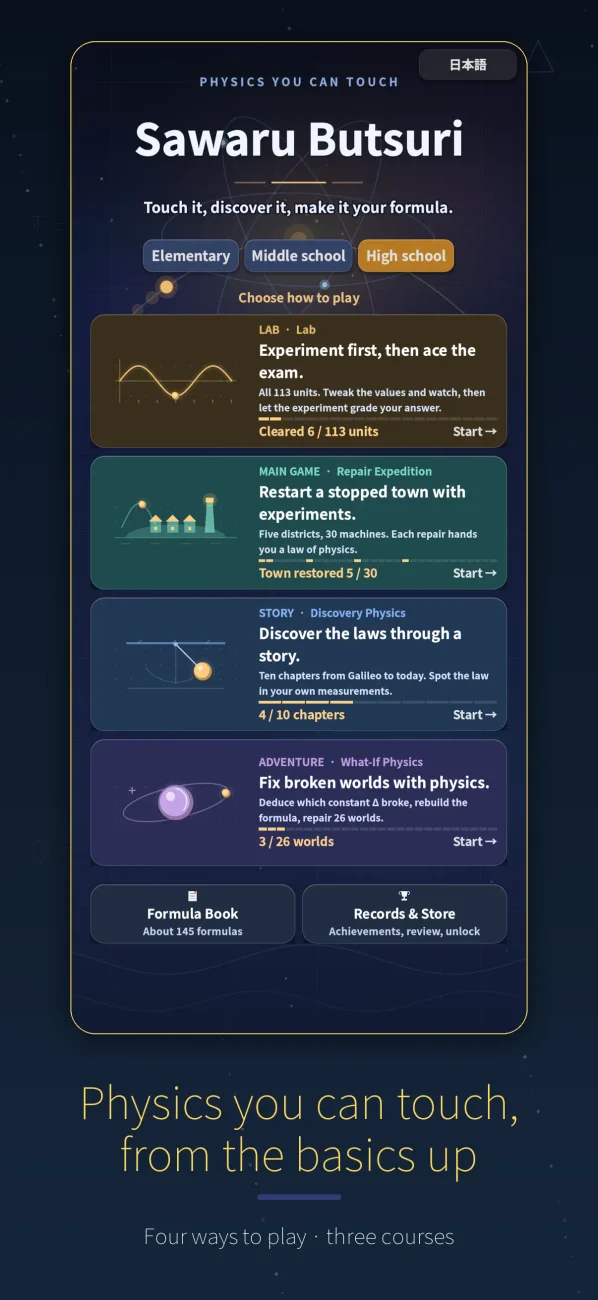
A town has stopped. Its five districts hold thirty machines, each running on a real law of physics. Tune launch power and angle until cargo reaches the far shore of a bridgeless harbor. Fix a machine and you earn its law and formula, and you learn which things do not matter.
▼ Three courses, one line
Three tabs on the home screen: Elementary, Middle school, High school. All stay open; a course is an entry point, not a lock. Elementary and Middle school show their own Lab. The three game modes below build on high-school physics, so they live in the High school course.
The Elementary course takes the physics part of elementary science, 46 units in four fields: electricity and magnets (12), forces and motion (18), light and sound (8) and heat (8). Basics come first: bulbs, magnets, pendulums, levers, shadows, ice. Mostly you pick "larger, the same or smaller", then the experiment shows what really happens. After the basics, 19 exam-level units take on the physics part of junior-high entrance exams in Japan: levers, pulleys, wheel and axle, springs, buoyancy, circuits, lenses, mixing water. They follow exam conventions (weights in grams, 1 cm³ of water = 1 g) and need only ratios, multiplication and division. Problems use easy words; menus are not rewritten for young readers.
The middle-school course covers the main physics topics in 43 units, in textbook order: light, sound, force and pressure, electric current, current and magnetism, motion, and work and energy. Mirrors, buoyancy, Ohm's law, motors, induction, action and reaction, all with proportions and arithmetic only. Both courses give every unit 4 to 5 problems that vary the numbers or conditions.
The high-school course covers all 113 units of the Japanese curriculum, from mechanics and waves to atomic physics.
Finish an elementary or middle-school unit and a door opens to the unit further up built on the same law (the lever leads to the moment of a force). Stuck further up? Step back to the basics from there.
▼ The Lab
Experiment Lab: the formula is shown large; change its values and watch the motion change. Exam Lab: read a problem, enter the number you calculated, and the simulation runs it and grades the result (within 0.5% is PERFECT).
▼ Discovery Physics
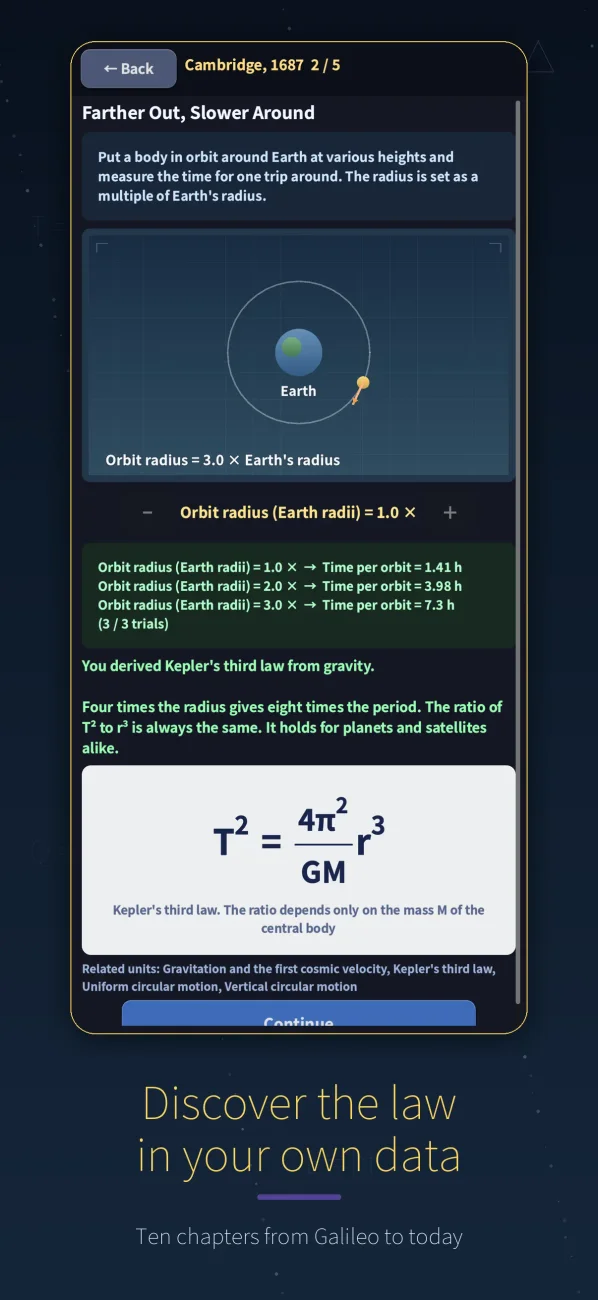
A ten-chapter story from Galileo's tower to a modern laboratory. You take the measurements and spot the law in your own data.
▼ What-If Physics
A being called Delta has been breaking physical constants. With the Professor you deduce which constant broke, rebuild the formula piece by piece, and repair 26 worlds.
▼ Also inside
• 30 advanced problems with diagrams; the numbers change every time.
• A formula book: about 145 high-school formulas, 55 middle-school ones, and 51 elementary rules stated in words.
• A formula-building calculator, spaced review, ranks, achievements, a five-minute time attack.
▼ How it's built
No ads. No account. No personal data is collected; the only network use is purchase processing. The first two machines of every district, three story chapters, three what-if worlds and three units of every lab field are included; a single purchase unlocks the rest in all three courses.
The middle-school course covers the physics part of the science curriculum only; static electricity, cathode rays and ray-diagram drawing are not included.
The Elementary course likewise covers physics only; living things, earth science, weather and chemistry are outside it.
Sawaru Butsuri is made by SNAPLACE LLC, a small Tokyo studio building a learning game for each school subject.
What’s new
Version 1.3.2 · Nov 20, 2026
v1.3.2
• Elementary course: the Experiment Lab now asks one short question with less text. The full problem is in the Exam Lab.
App privacy
What SNAPLACE declares on the App Store about how this app handles data.
-
Data not collected
The developer does not collect any data from this app.
Privacy practices may vary, for example with the features you use or your age.
Information
- Seller
- SNAPLACE LLC
- Category
- Education
- Version
- 1.3.2
- Updated
- Nov 20, 2026
- Released
- Oct 2, 2026
- Size
- 112.4 MB
- Requires
- iOS 17.0 or later
- Age rating
- 4+
- In-app purchases
- Yes
- Languages
- Japanese, English
- Copyright
- © SNAPLACE