Chemical Elements Quiz & Study
Quiz on the chemical elements
Designed for iPhone, iPad, iPod touch
Free · In-app purchases
- Age rating4+
- CategoryEducation
- DeveloperAbdulkarim Nasir
- LanguagesEnglish
- Size17.2 MB
Links to the official App Store page
Download.org hosts no file of Chemical Elements Quiz & Study. The button opens its official App Store page, published by Abdulkarim Nasir. Listing last checked on Nov 12, 2026.
Screenshots

About
Put your knowledge of the periodic table to the test with this entertaining chemical elements quiz app!
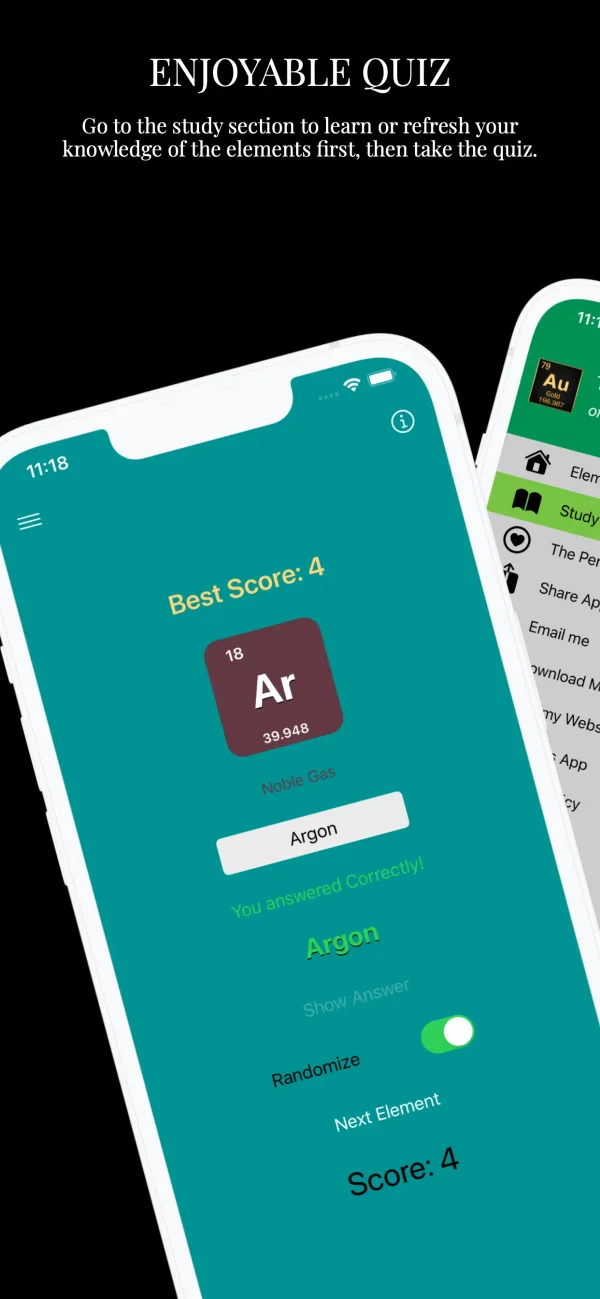
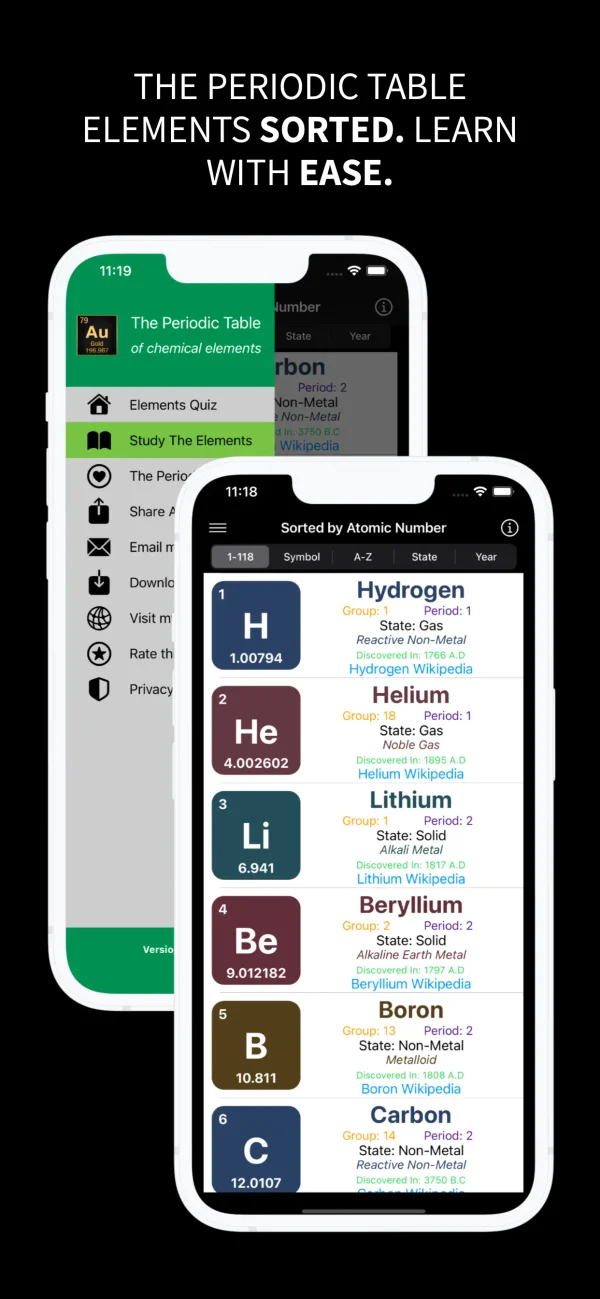
Unlike other apps where you're presented with options where you can make mere guesses, this app demands that you type the name of the chemical element of the periodic table! Study the elements then take the quiz.
How to play:
1. Start by typing the element's name. Once you're done, dismiss the keyboard by clicking return or by tapping any part of the screen. Next, click the "Show Answer" button to reveal the name of the chemical element to verify your answer. If your input matches the chemical element's name, you win, otherwise no!
2. Click the "Next Element" button to go to the next element.
3. Turn on "Randomize" switch to get the chemical elements randomly.
In 1789, French chemist Antoine Lavoisier tried grouping the elements as metals and nonmetals. Forty years later, German physicist Johann Wolfang Döbereiner observed similarities in physical and chemical properties of certain elements. He arranged them in groups of three in increasing order of atomic weight and called them triads, observing that some properties of the middle element, such as atomic weight and density, approximated the average value of these properties in the other two in each triad.
A breakthrough came with the publication of a revised list of elements and their atomic masses at the first international conference of chemistry in Karlsruhe, Germany, in 1860. They concluded that hydrogen would be assigned the atomic weight of 1 and the atomic weight of other elements would be decided by comparison with hydrogen. For example, carbon, being 12 times heavier than hydrogen, would have an atomic weight of 12.
British chemist John Newlands was the first to arrange the elements into a periodic table with increasing order of atomic masses. He found that every eight elements had similar properties and called this the law of octaves. He arranged the elements in eight groups but left no gaps for undiscovered elements.
In 1869, Russian chemist Dmitri Mendeleev created the framework that became the modern periodic table, leaving gaps for elements that were yet to be discovered. While arranging the elements according to their atomic weight, if he found that they did not fit into the group he would rearrange them. Mendeleev predicted the properties of some undiscovered elements and gave them names such as "eka-aluminium" for an element with properties similar to aluminium. Later eka-aluminium was discovered as gallium. Some discrepancies remained; the position of certain elements, such as iodine and tellurium, could not be explained.
German chemist Lothar Meyer produced a version of the periodic table similar to Mendeleev’s in 1870. He left gaps for undiscovered elements but never predicted their properties. The Royal Society of London awarded the Davy Medal in 1882 to both Mendeleev and Meyer. The later discovery of elements predicted by Mendeleev, including gallium (1875), scandium (1879) and germanium (1886), verified his predictions and his periodic table won universal recognition. In 1955 the 101st element was named mendelevium in his honor.
The concept of sub-atomic particles did not exist in the 19th century. In 1913, English physicist Henry Moseley used X-rays to measure the wavelengths of elements and correlated these measurements to their atomic numbers. He then rearranged the elements in the periodic table on the basis of atomic numbers. This helped explain disparities in earlier versions that had used atomic masses.
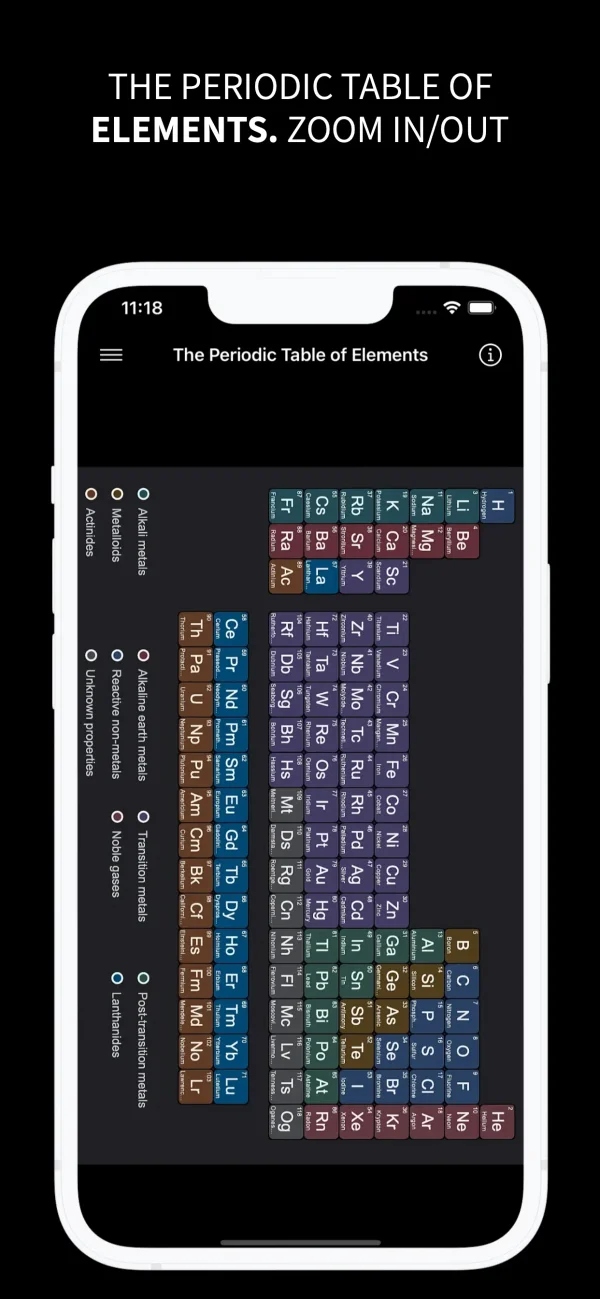
In the periodic table, the horizontal rows are called periods, with metals in the extreme left and nonmetals on the right. The vertical columns, called groups, consist of elements with similar chemical properties. Scientists use the table to study chemicals and design experiments. It is used to develop chemicals used in the pharmaceutical and cosmetics industries and batteries used in technological devices.
What’s new
Version 1.4 · Jan 2, 2025
Fewer ads...
App privacy
What Abdulkarim Nasir declares on the App Store about how this app handles data.
-
Data not linked to you
May be collected but is not linked to your identity.
- Identifiers
- Usage data
Privacy practices may vary, for example with the features you use or your age.
Information
- Seller
- Abdulkarim Nasir
- Category
- Education
- Version
- 1.4
- Updated
- Jan 2, 2025
- Released
- Nov 22, 2023
- Size
- 17.2 MB
- Requires
- iOS 13.0 or later
- Age rating
- 4+
- Price
- Free
- In-app purchases
- Yes
- Languages
- English
- Copyright
- © AbdulKarim Nasir
You might also like
-
 Elements Periodic Table QuizSymbols, Atomic Numbers & More
-
 Periodic Table Elements MasterLearn Faster, Retain More!
-
 Elements Study GuideEducation
-
 Elemental Periodic Table QuizInteractive Learning Hub
-
 Elements - Flashcards and QuizLearn the Periodic Table
-
 Chemical Elements PracticeMaster the periodic table
-
 MyKanjiKanji Kentei 10-kyu to 1-kyu
-
 Rapid Skills MultiplicationEducation
-
 ZiyarahGuiding Your Sacred Journey
-
 Statistics - StatRiseCalculator & AP Exam Prep