Ventlas
Ventilator waveforms & patient
Được thiết kế cho iPhone, iPad, iPod touch
Miễn phí
- Độ tuổi4+
- Danh mụcGiáo Dục
- Nhà phát triểnSang Joon Park
- Ngôn ngữTiếng Anh
- Kích thước2,7 MB
Liên kết đến trang App Store chính thức
Download.org không lưu trữ tệp nào của Ventlas. Nút này mở trang ứng dụng trên App Store, nơi Sang Joon Park phát hành ứng dụng. Trang được kiểm tra lần cuối: 12/11/2026.
Ảnh chụp màn hình
Giới thiệu
Nhà phát triển chưa cung cấp nội dung này bằng ngôn ngữ của bạn.
Don't memorize ventilator waveforms. Watch them being made.
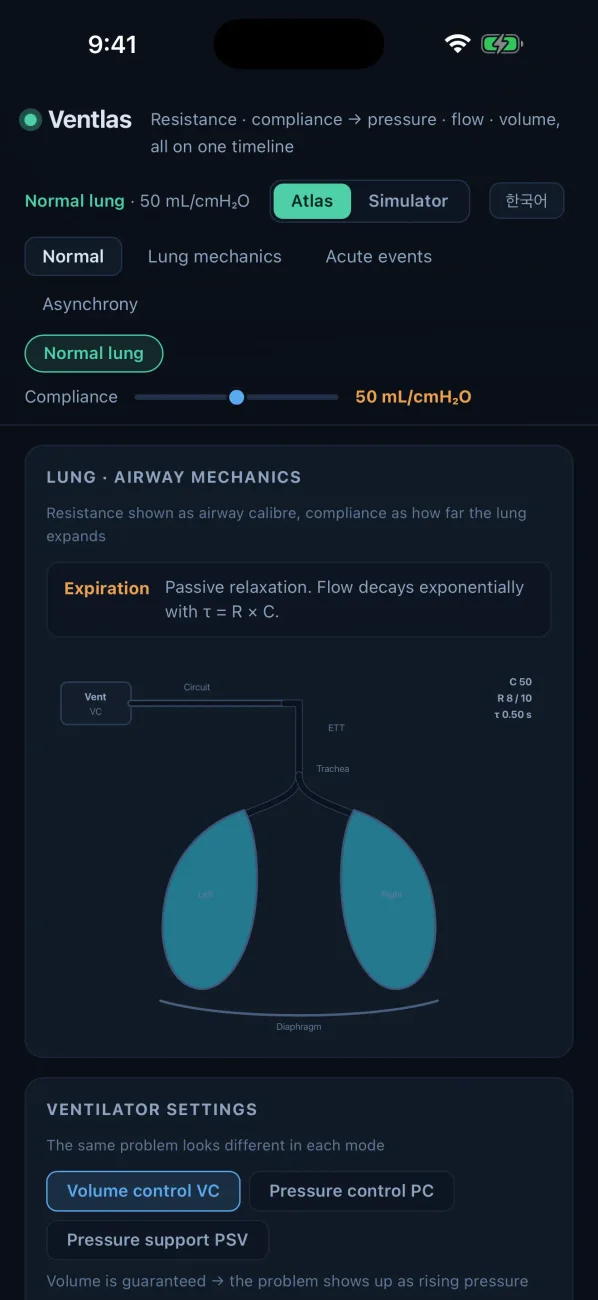
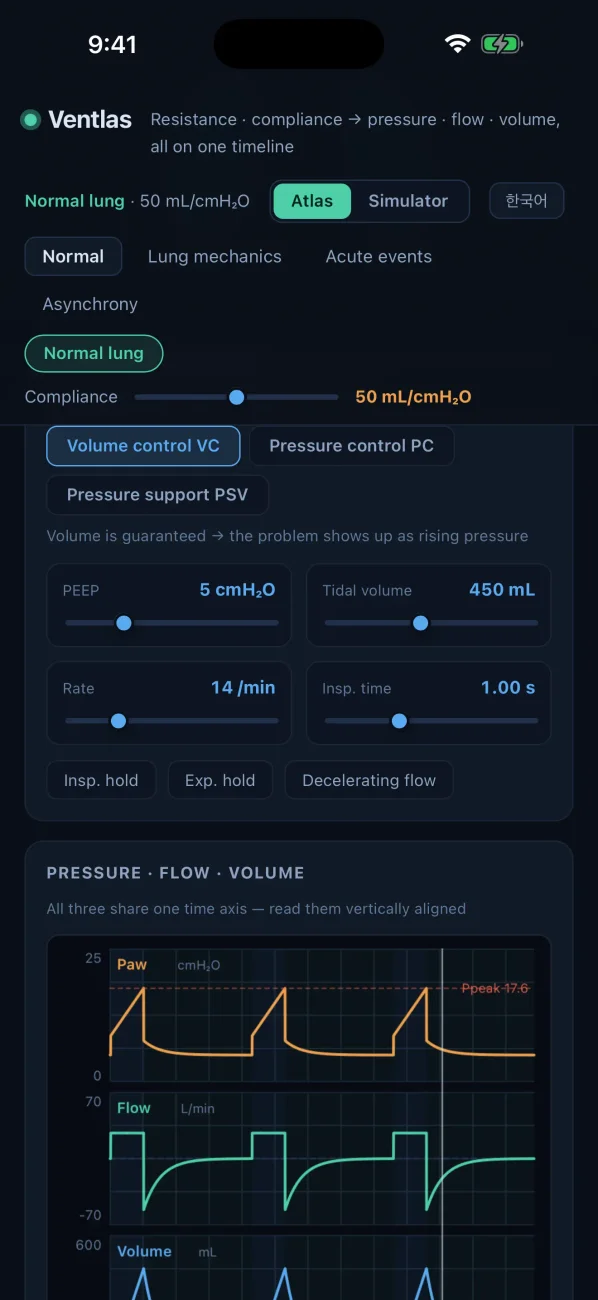
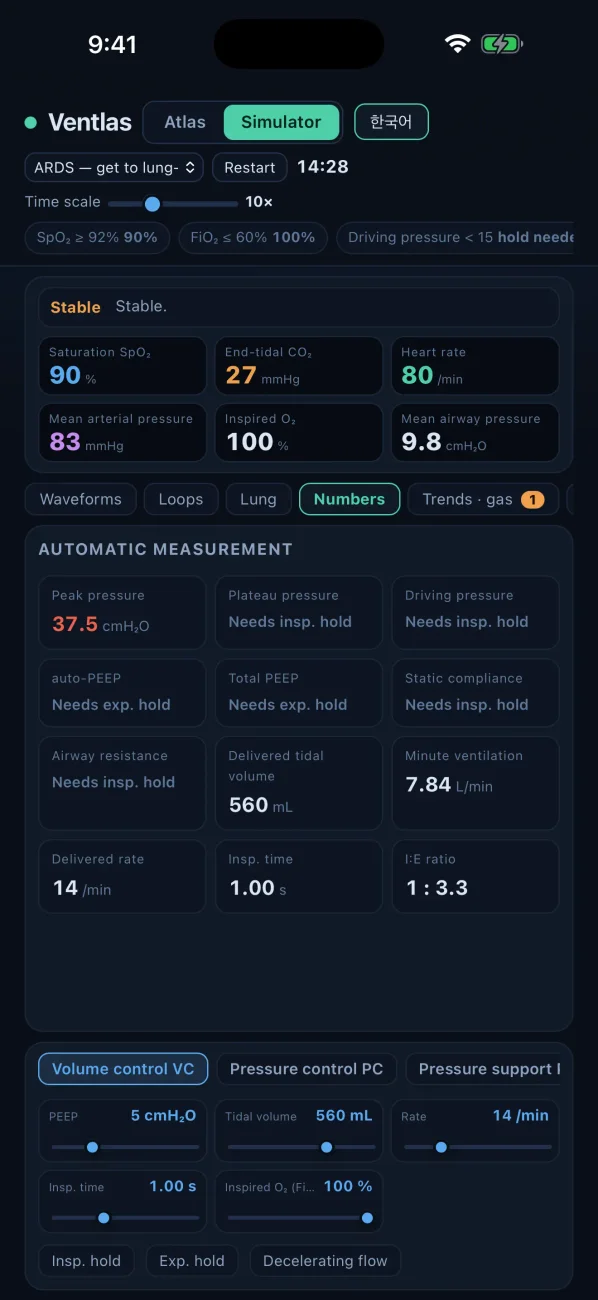
Ventlas is an educational simulator that computes pressure, flow and volume waveforms from resistance and compliance using a single-compartment lung model. Nothing is hand-drawn: every trace is integrated from the equations, breath by breath. Because residual volume carries over between breaths, auto-PEEP emerges from the arithmetic rather than being painted in.
[ ATLAS - 17 conditions ]
Normal lung / ARDS / COPD and asthma / Cardiogenic pulmonary edema / Obesity and raised abdominal pressure / Atelectasis / Pulmonary fibrosis
Mucus plug / Kinked tube / Tension pneumothorax / Endobronchial intubation / Circuit leak
Double triggering / Flow starvation / Ineffective triggering / Auto-triggering / Reverse triggering
Each condition is explained in four panels - mechanism, mechanics, waveform, clinical - with a severity slider in real units. What matters is what separates conditions that look alike:
- Atelectasis vs fibrosis: does compliance improve when you raise PEEP?
- Kinked tube vs mucus plug: does pressure fall in proportion to flow, or with its square?
- Auto-triggering vs reverse triggering: does the negative deflection come before the breath, after it, or not at all?
[ THREE MODES ]
Volume control / Pressure control / Pressure support
The same problem looks different in each mode, and that is the teaching point. Volume control shows it as rising pressure; pressure control shows it as falling volume. In pressure support the breath ends on flow rather than time, so high resistance stretches inspiration out.
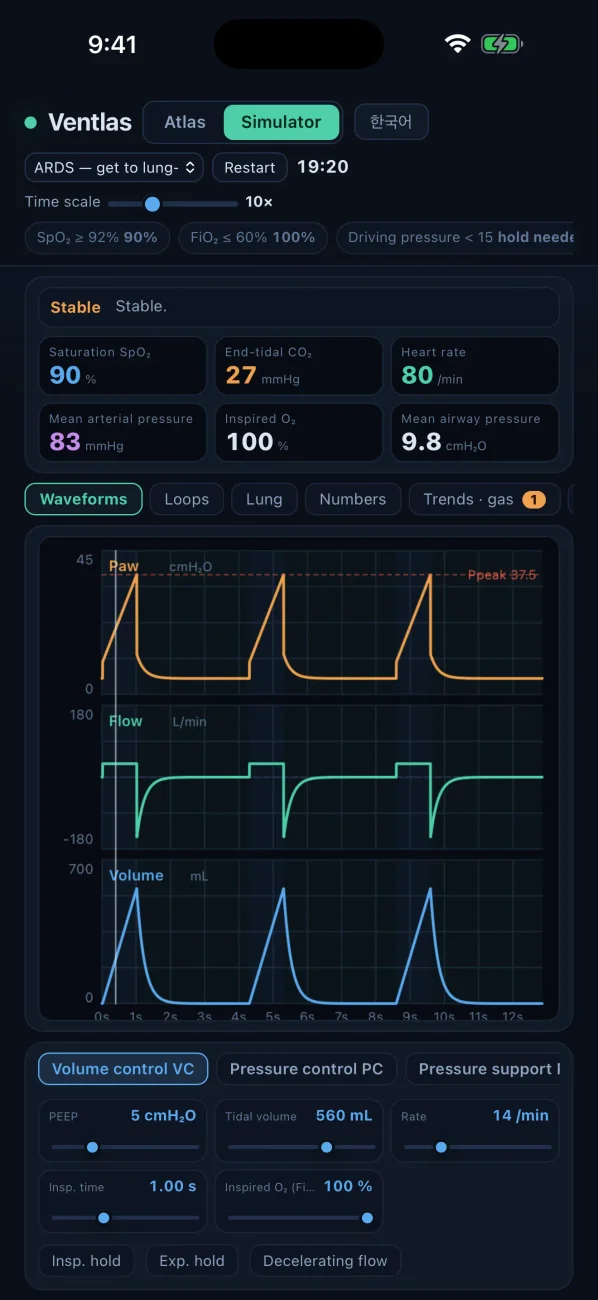
[ SIMULATOR - the patient answers back ]
Work the ventilator and the patient changes over minutes.
Saturation, end-tidal CO2, heart rate and mean arterial pressure are monitored continuously.
An arterial blood gas takes two minutes to come back, and the result is the patient as they were when you drew it - not as they are now.
Four scenarios with targets: ARDS, COPD, atelectasis, circuit leak.
Every setting you change is logged with the vital signs of that moment, and the whole session can be exported at the end.
[ MEASUREMENTS THAT REFUSE ]
No plateau pressure without an inspiratory hold.
No auto-PEEP without an expiratory hold.
No compliance when patient effort or a leak makes it meaningless.
Knowing why a number cannot be measured matters as much as the number.
Korean and English. Works entirely offline.
No account, no ads, no in-app purchases, no data collected.
This is a medical education simulator. It is not a medical device and must not be used for diagnosis or to set a real ventilator. Every value shown is computed from a mathematical model and is not a recording from a real patient.
Có gì mới
Phiên bản 1.1 · 25/08/2026
A warmer screen and a new quiz mode.
Quiz mode
Stabilise a randomly drawn case within two minutes. Meet every target and hold it for fifteen seconds to win. Three difficulties — on easy you are told the whole case and the patient drifts slowly. On medium only the diagnosis is named, the patient moves fast, and deteriorates once along the way. On hard you are told nothing: read the waveform and the vitals yourself, and name the diagnosis when time is up.
Time comes back to the loops
Pressure-volume and flow-volume loops are pictures with the time axis erased — frozen, they are just a closed ring. Now each phase has its own colour, and a dot marks the same instant the waveform cursor marks, travelling around the loop. Arrows show which way the ring turns, and a line above the loops says what each one is doing in the current phase.
Overlay a normal lung
See what your current ventilator settings would have produced on a healthy lung, ghosted behind your waveform. Wherever the two diverge is the pathology.
Look and feel
A warmer palette throughout. PEEP, rate and the rest are set with large minus and plus buttons that repeat when held. Scrolling is no longer blocked when your finger lands on a graph. The three waveforms now lie beneath the lung diagram at the same instant, and a floating mini panel keeps them running while you read the notes.
Five new scenarios
Status asthmaticus (auto-PEEP), double triggering, ineffective effort, auto-triggering and flow starvation. Scoring them added an asynchrony index and an inspiratory pressure-dip measurement, and trigger sensitivity is now a setting you can turn.
A medical education simulator. Not a medical device; not for diagnosis or for setting a real ventilator.
Quyền riêng tư của ứng dụng
Những gì Sang Joon Park khai báo trên App Store về cách ứng dụng này xử lý dữ liệu.
-
Dữ liệu không được thu thập
Nhà phát triển không thu thập bất kỳ dữ liệu nào từ ứng dụng này.
Phương thức đảm bảo quyền riêng tư có thể khác nhau, chẳng hạn như tuỳ theo các tính năng bạn sử dụng hoặc độ tuổi của bạn.
Thông tin
- Người bán
- Sang Joon Park
- Danh mục
- Giáo Dục
- Phiên bản
- 1.1
- Cập nhật
- 25/08/2026
- Phát hành
- 21/08/2026
- Kích thước
- 2,7 MB
- Yêu cầu
- iOS 15.0 trở lên
- Độ tuổi
- 4+
- Giá
- Miễn phí
- Ngôn ngữ
- Tiếng Anh
- Bản quyền
- © 2026 Sang Joon Park
Có thể bạn cũng thích
-
 PICULab: Ventilator SimulatorGiáo Dục
-
 BronchoQuestGiáo Dục
-
 NBRC CRT Exam Prep Test 2026Giáo Dục
-
 HemoScopeCVICUGiáo Dục
-
 Dr.AI Libyan AssistantGiáo Dục
-
 Anesthesia Tech Exam Prep 2026Giáo Dục
-
 Kalila wa Dimna IllustratedGiáo Dục
-
 Poly Poser - 3D Anatomy ToolGiáo Dục
-
 MediPrep: Med School LecturesGiáo Dục
-
 NBRC RRT Flashcards 2026Giáo Dục