
- Age rating17+
- CategoryMedical
- DeveloperPablo Kessler Saiz
- LanguagesEnglish
- Size137.4 MB
Links to the official App Store page
Download.org hosts no file of SimShockPad. The button opens its official App Store page, published by Pablo Kessler Saiz. Listing last checked on Nov 15, 2026.
Screenshots
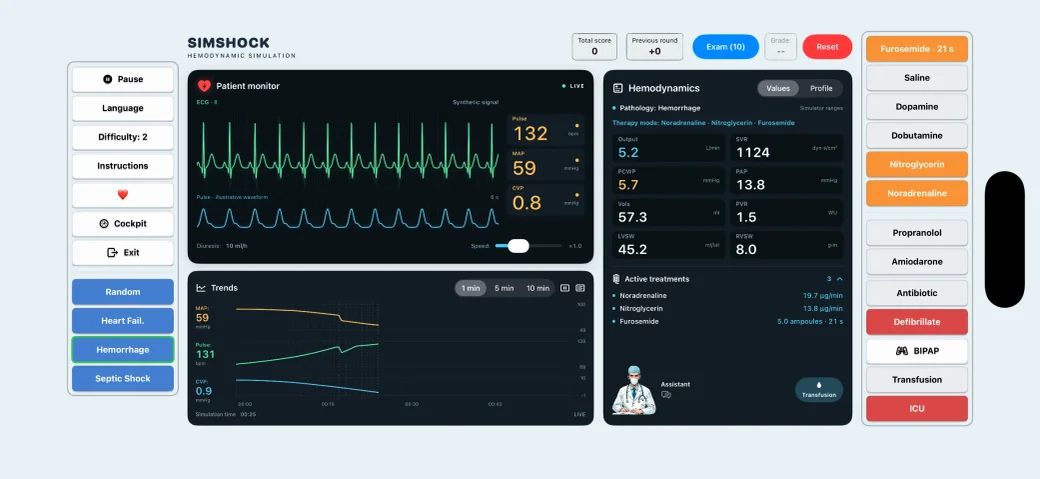

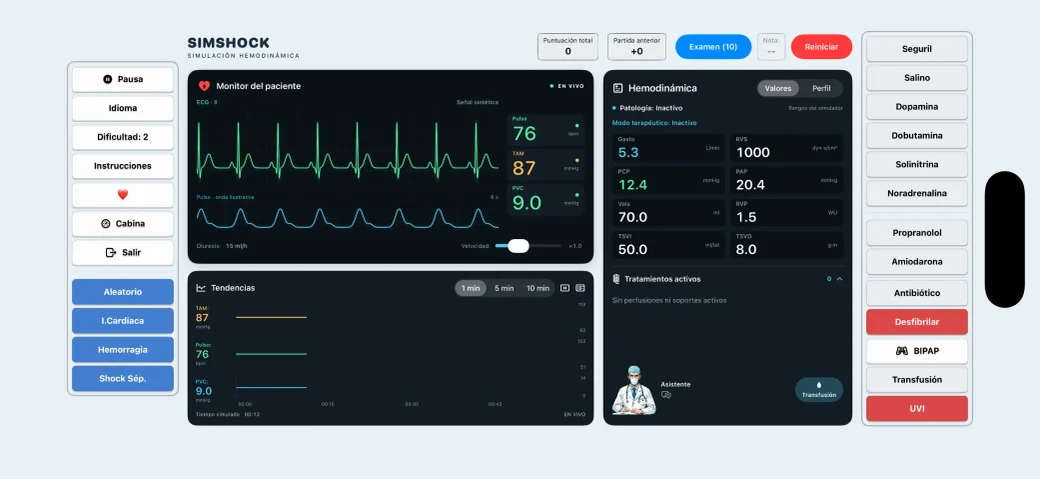
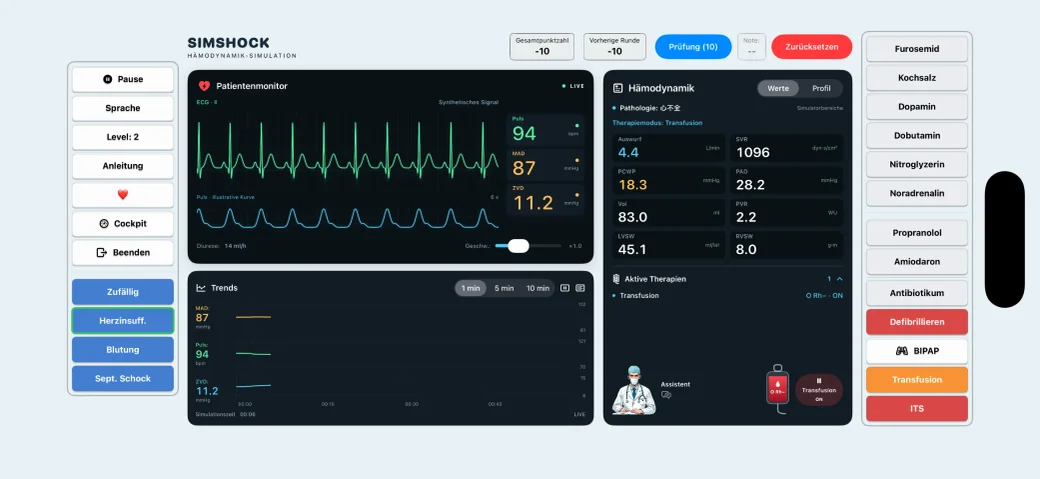

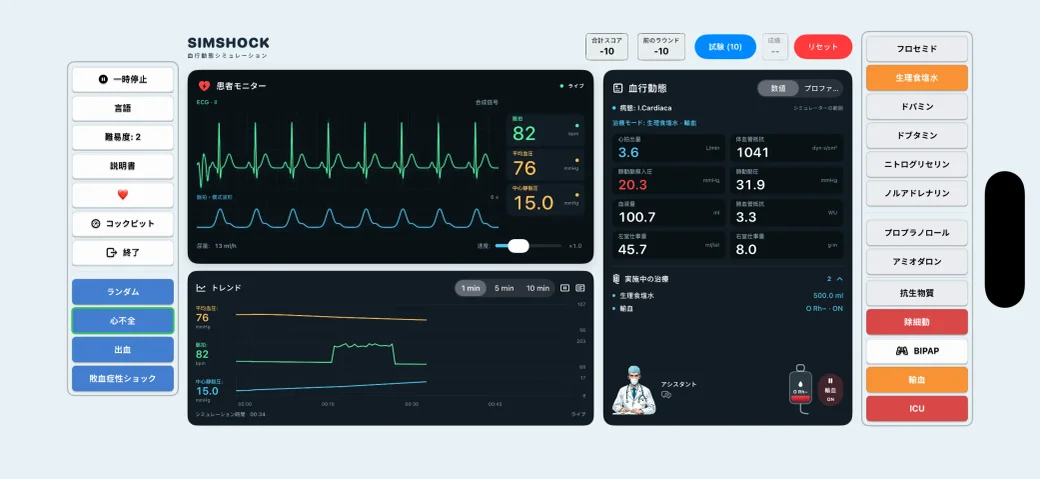
About
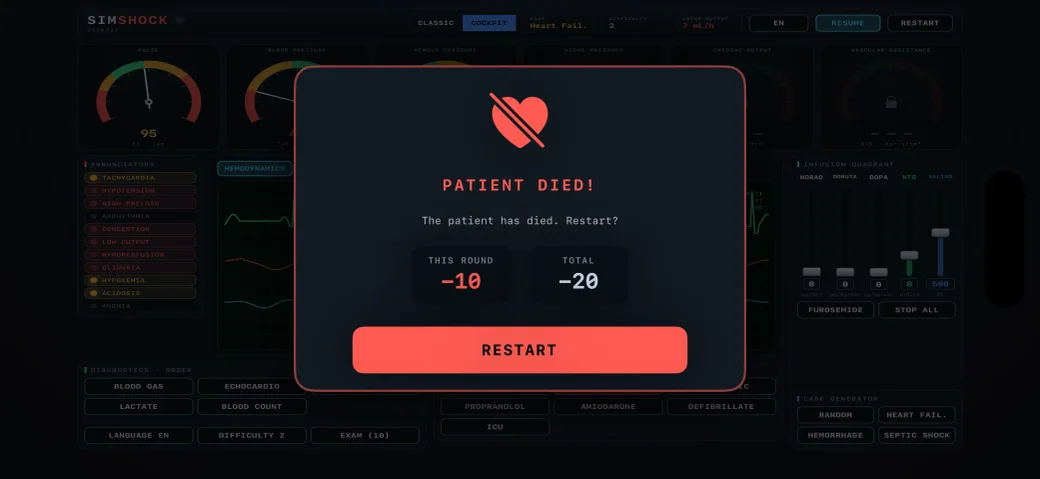
SimShock is a hemodynamic simulation game. It is not a teaching or instructional tool, nor is it a clinical simulator.
Think of it as a home flight simulator: true to the spirit, carefully made, but still a game.
One critically ill patient, vital signs changing in real time, and very little room for error. The patient may arrive with heart failure, massive hemorrhage, septic shock or an arrhythmia. Each condition behaves differently, and what saves one patient can sink another.
NEW HEMODYNAMIC ENGINE
A new model links heart rate, stroke volume, cardiac output and vascular resistance to filling pressures. The baroreflex has two arms and can become exhausted, each patient has an individual sensitivity to each drug, and infusions have a therapeutic window: inside it they do their job; outside it, they do something else. No drug has a hard ceiling — if you overdo it, you will see the consequences.
Real physiology is far more complicated. Many rules have been deliberately simplified to make the game playable.
THE THREE SCREENS
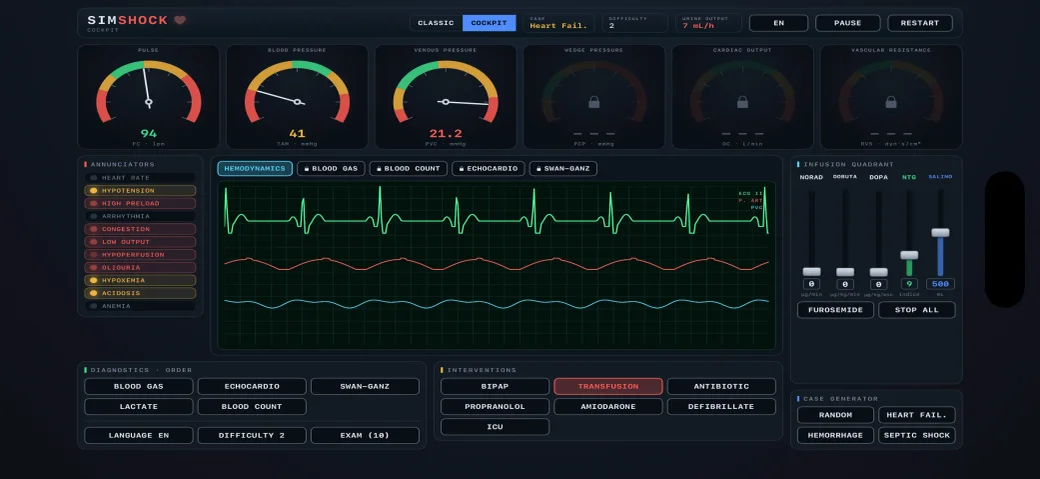
· Monitor — real-time ECG and pulse waveform, with systolic pressure, heart rate and venous pressure shown in traffic-light colors. Ventricular and supraventricular arrhythmias may develop spontaneously during a case.
· Hemodynamics — cardiac output, cardiac index, vascular resistance, capillary and pulmonary pressures, stroke volume, blood volume and ventricular work, displayed as either values or a profile.
· Trends — 1-, 5- and 10-minute evolution with an event log: this is where you can see exactly where the game went wrong.
ACTION BUTTONS
· Norepinephrine — at high doses, increased resistance chokes the ventricle: capillary pressure rises and cardiac output falls.
· Dobutamine — increases cardiac output without increasing blood pressure. At high doses: tachycardia and hypotension.
· Dopamine — above 20 µg/kg/min it irritates the ventricle: ectopic beats after ten seconds, ventricular tachycardia after twenty-five.
· Nitroglycerin — unloads the lungs quickly, and can take the blood pressure down with it if the patient has little to spare.
· Furosemide — makes a difference in the fluid-overloaded patient, not in the dry one, no matter how high you turn it up.
· Saline and transfusion — finite bags: every milliliter counts.
· Antibiotics — three regimens and one source of infection. Only the regimen that covers it works, and the infection itself must be controlled (Infection Control button).
· Antiarrhythmics — adenosine, diltiazem, esmolol, propranolol, procainamide and amiodarone.
· Defibrillator, non-invasive ventilation and transfer to intensive care.
· Transfusion — transfusing alone is not enough: the bleeding must also be controlled (Bleeding Control button).
THE CONTROLS
· Notes — the assistant tells you what the patient still needs to become stable.
· The doctor — tap to switch between a male and female doctor. If things go wrong, the expression changes.
· Events — a log of what you did and when.
· Pause — freezes time. Speed makes it run faster or slower.
· Difficulty — changes how the patient evolves, not the reference ranges.
· Arrhythmias — from off to a randomized 30% probability, or automatic according to difficulty.
· Patient — variable or standard. Switch it off if you want reproducible games.
· Random — hides the condition name and switches off the traffic lights: you have to read the numbers.
· Exam — ten consecutive cases with scoring.
· Cockpit — switches between the classic interface and the command-station view without losing the current game.
· Language, Instructions and volume from 0 to 100 next to the clock, with a separate mute control.
NOTICE
SimShock is a game that represents pathophysiological situations in a simplified way. It is not an educational tool or a clinical guide, and it does not provide medical advice or recommendations. Always consult healthcare professionals.
What’s new
Version 10.6 (Iphone Duo) · Oct 28, 2026
iPhone Duo support:
With iPhone Duo unfolded in portrait, the patient monitor and hemodynamics fill the top screen, and the treatment buttons sit on the bottom screen.
Dosage and instruction dialogs, as well as outcomes (ICU, cure and death), open on the top screen without crossing the hinge.
In landscape and when folded, SimShock looks the same as before.
App privacy
What Pablo Kessler Saiz declares on the App Store about how this app handles data.
-
Data not collected
The developer does not collect any data from this app.
Privacy practices may vary, for example with the features you use or your age.
Information
- Seller
- Pablo Kessler Saiz
- Category
- Medical
- Version
- 10.6 (Iphone Duo)
- Updated
- Oct 28, 2026
- Released
- Jun 9, 2025
- Size
- 137.4 MB
- Requires
- iOS 17.6 or later
- Age rating
- 17+
- Price
- Free
- Languages
- English
- Copyright
- © 2025 Pablo Kessler Saiz
You might also like
-
 Antibiotic: ER Quick GuideSuper-simple antibiotic guide
-
 Critical Care VaultCritical care training & tools
-
 ICBCCInternet Chatbot of Crit Care
-
 Cardiac Diagnosisheart health care
-
 Code Blue MonitorECG & Defibrillator Simulator
-
 ACLSMED SimACLS PALS BLS ECG SIMulator
-
 gistaltan emergency medicine game
-
 ER NAVNavigate to Ambulance Bays
-
 Evidence AtlasFrom The POCUS Atlas
-
 Safe VentFORVEMEC